Wednesday, 4 August 2010

THE NATIONAL ARCHIVES OF SCOTLAND

Site Visit: 7/20/10
“FORM FOLLOWS FUNCTION”

We have been very fortunate to have seen some extraordinary library buildings on this tour. I am thinking perhaps of the Bodleian Library, or the more contemporary British Library. We have also seen some rather more prosaic buildings. The Barbican Library, although very functional and very well used, sits in a harsh urban environment and is not very pretty.

Robert Adam: http://the100.ru/images/architect/id208/227-robert-adam-1-sized.jpg

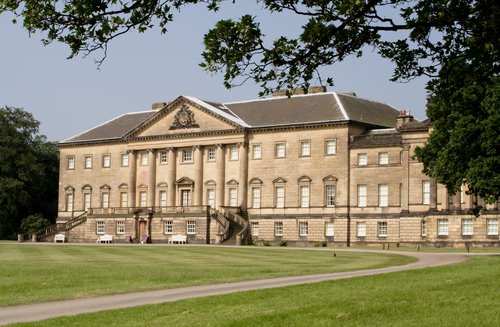
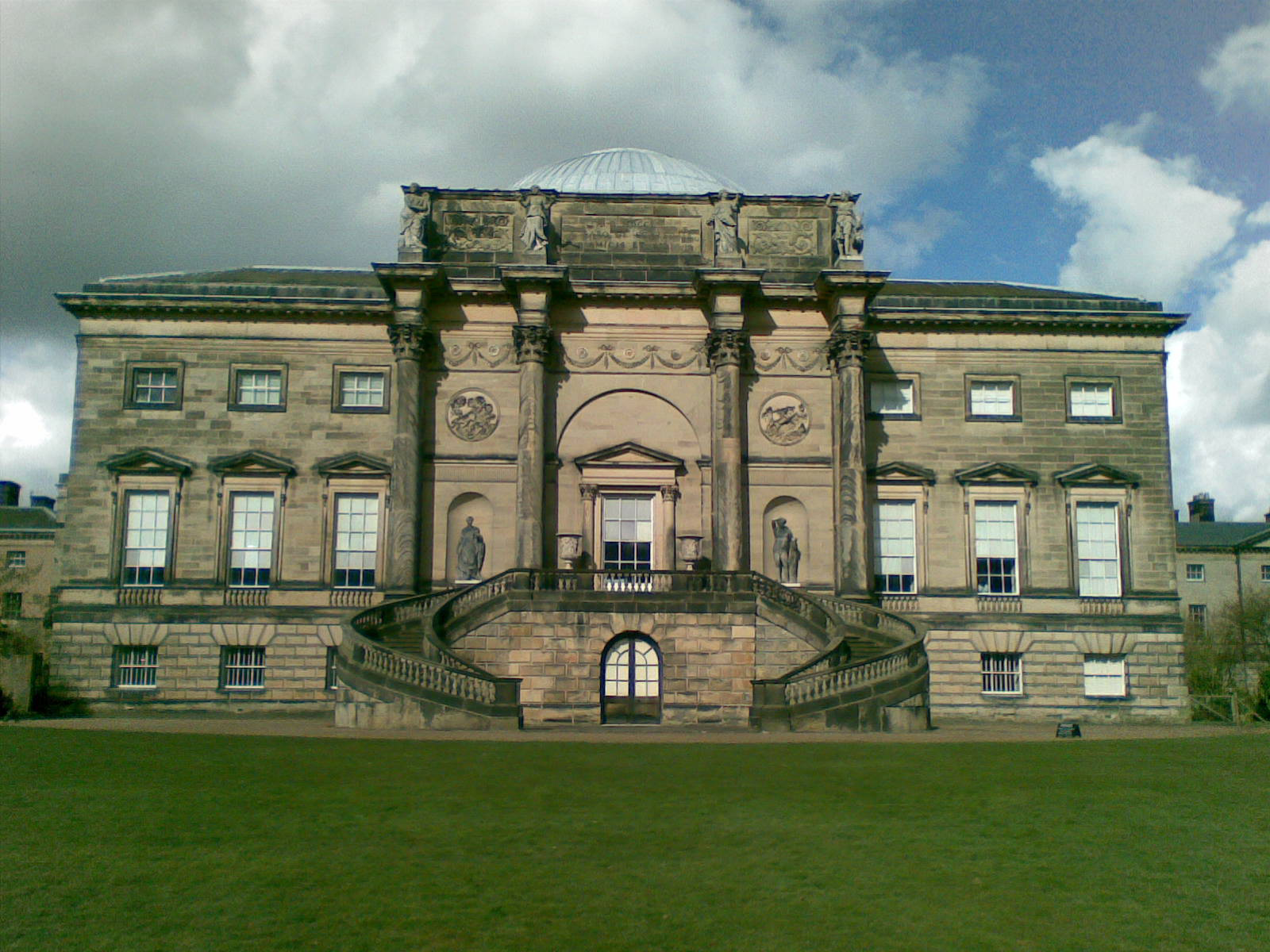
The National Archives of Scotland, housed in General Register House, however, really spoke to me today. It is not very often that you can get “up close and intimate” with a building designed by the architect Robert Adam. We have been very privileged today. Robert Adam (1728-92) was born in Scotland, and was one of Britain’s finest architects. He took the classical architecture of ancient Greece and Rome, and via the neo-classical architect, Palladio, he designed functional and beautifully stylish buildings in the Palladian style. His style became known as “Adam style”. He designed furniture and internal fittings for his clients, as well as some of Britain’s most stylish stately homes. Nostell Priory, Harewood House (both in West Yorkshire) and Kedleston Hall (in Derbyshire) are the epitome of cool classical elegance. 1

Nostell Priory: http://www.planetware.com/i/photo/nostell-priory-wakefield-gb856.jpg


Harewood House:
http://robertarood.files.wordpress.com/2007/12/harewood_house_seen_from_the_garden.jpg

Kedleston Hall:
http://upload.wikimedia.org/wikipedia/commons/8/8e/South_Front_of_Kedleston_Hall.png

Our “building guide”, Dr. Tristram Clarke, explained that the General Register House was the first purpose-built public record repository building to be built in Great Britain. The fact that the building is still “fit for purpose” some 236 years after the building was started in 1774, is a testament to the vision and foresight of this versatile and talented architect. In 1896, American architect Louis Sullivan wrote that “form follows function”. 2 He meant that the form a building takes should match the purpose/function to which it is to be put. In this building, Adam succeeded perfectly in having the form of his building suit the function of a library.


So why is this building so significant? The plan is unique, in that Adam built a hollowed-out square plan, in which are ranged offices and storage areas. The inner line of the square space is filled with a rotunda. This room, which Dr. Clarke showed us, is an architectural tour-de-force. Modelled on the Pantheon in Rome, it is 50’ in diameter and 80’ high. The mouth-watering feature of this space is the circular sky-light, which floods natural light into the reading room below.


A suspended galleried floor provides upper-level access to wall-mounted shelves. Surprisingly, although highly functional, unusually for Adam, these shelves are not very well made. Doors leading off the upper and lower level floors lead to irregularly-shaped storage areas, which like the Rotunda walls, are all filled with books.

Adam was famous for using highly decorative plaster work. Thomas Clayton, Jnr., was responsible for the plaster decoration to the interior dome surfaces. He formed in plaster, the thistle, the national flower of Scotland and it is seen counter-pointed with the rose emblem of England. The real eye-candy, though, are the classical bas-relief designs picked out in Wedgewood blue that circle the dome at mid-level.


The tour continued in the basement, where a series of massive brick pillars support the building. These are pierced with voids, which allowed the Adams-designed hypocaust system to circulate warm air throughout the building. The “sprung” staircases, built later, link the rotunda with the external “office” structure in a most pleasing way. The stairwell is topped off with much elegant classical ornamentation.


Fire suppression was considered to be a significant element of Adam’s design. The walls and floors of the building are built in stone (lined with plaster) as a fire deterrent. The connecting doors to the research room are made from cast iron and painted to look like mahogany, to add to the fire-proofing defenses.

I consider myself to have been most fortunate to have gone on this tour. Robert Adam truly built a structure in which “form follows function”. I am most envious of the staff who work in such a sumptuous building.


1 “Robert Adam” http://www.wikipedia.org/. Accessed 7/20/10.
2 “Louis Sullivan” http://www.wikipedia.org/. Accessed 7/20/10.

Friday, 30 July 2010

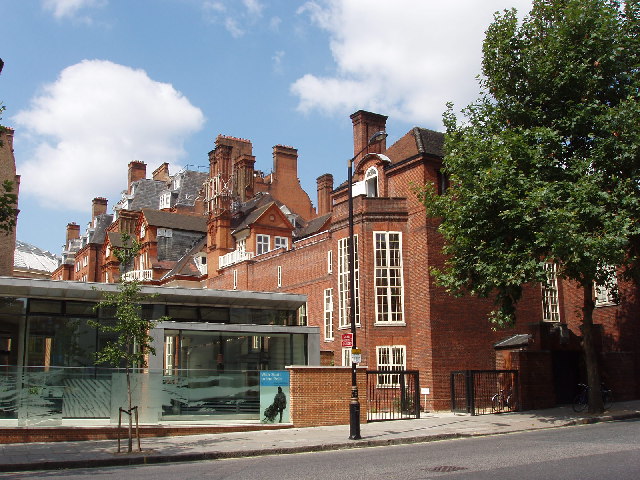
KING'S COLLEGE LONDON: MAUGHAN LIBRARY


King’s College London, is the fourth oldest university in England, has an enrollment of 23,000 students, of which over a third are graduate students. The university comprises many different campuses, most of which are in central London. Internationally recognized faculties of law, nursing and medicine are complemented by strong representation in the humanities and social sciences.

Our initial tour guide for the Maughan Library (Strand Campus) was Sally Brock, who is a librarian. She explained that four smaller libraries had been amalgamated in 2001, when the vacant buildings that had formerly housed the Public Records Office became available. The national Public Records Office is now housed at Kew in Southwest London. The building has Grade II* status, which means that prior approval from English Heritage has to be sought for any changes to be made to the building. The building was originally built in 1851, and load-bearing considerations became a real issue when the conversion to a library was being considered. Plans to create fashionable open space collaborative work areas, foundered on the same rocks.

This is not a public library, although external graduate and undergraduate researchers are encouraged to use the library. The Strand Campus is the home to the humanities faculties, and the Maughan library services the needs of some 11,000 students. However, students in remote campuses have university-wide reading and borrowing access. The library is open seven days per week, with hours ramping up to 24/7 at exam times. The library has subject specialists and is going to the self-service check-out system (RFID) in the fall.

Michael, our second tour guide took over, explaining the cell-like construction of the original building. There were many fire protection features that were considered in the 1851 designs. Rooms were built with fire-proof doors, with exposed timbers being clad in zinc, and then painted to look like wood. A huge water cistern built high in the external bell tower could be called upon by fire-fighters if the need arose. Looking at the beautiful Victorian Gothic exterior, one would never know the cistern was there.


We toured an original 1851 “cell” that has been left with the original fire-proof shelves. They are made from slate, to help with fire retardation, all supported on a steel framework, which carries a mezzanine level. These shelves would mostly have stored rolls of parchment. The rolls would then have been stacked, perhaps five high, which accounted for the small gaps between the shelves.

Having seen the computer labs, we then went into the Central reading room. The beautiful proportions of this elegant top-lit space were copied from the reading room at the British Museum. This reading room contains humanities reference materials and space for approximately 45 readers. An inner-leaf ceiling made from zinc is suspended underneath the roof and painted with to a very pleasing effect.


Hugh Carrol was our guide for the Foyle Special Collections Library. The collection contains about 150,000 items at a conservative estimate. Being quite small, the library has space for 12 readers, who are invigilated by a member of staff when the reader is accessing an item. The collection is maintained to British Standard (BS) 5454, which governs appropriate levels for humidity, temperature, security, etc. Hugh showed us many interesting items demonstrating the strength of materials collected by appropriate teaching departments. The medical and nursing faculties, for example, were represented by several ancient medical texts and an 1859 nursing report drawn up by Florence Nightingale on the post-combat fatality rate of soldiers in the Crimea War.

Care for the Foreign and Commonwealth Historical Archive has recently been inherited by Hugh and his two full-time colleagues. This collection contains a vast amount of early materials relating to the creation of the British Empire. Hugh told us that there is a large amount of material on the slave trade and on the history of emigration to Australia. Cataloging is under way, with a retrospective card catalog being created in tandem with the new computer records. Once completed, this will be a huge boon to researchers working on how “Britain” became “Great Britain”.

This was a most interesting tour, if only from the point of view of early fire retardation techniques. This is a very elegant Victorian building, which has been given a new and appropriate lease of life.


Background information gathered at: http://www.kcl.ac.uk/about/
Library website: http://www.kcl.ac.uk/iss
Check out the 360 degrees web-site at: http://www.kcl.ac.uk/virtualtour/strand-campus.html

Thursday, 29 July 2010

BRITISHNESS (vi): WORDS

THE NIGHT MAIL

It will come as no surprise, as you read further into this blog, to discover that I am fascinated by words. I am equally entranced by the shape of the words on the page, as I am by the sound they make. The words bubble, nemesis or idiosyncratic each have their own form, cadence and character. The English language has a vocabulary that is wider and more varied than any other in the world. We are the proud inheritors of billions upon billions of utterances.

In 1936, the General Post Office (GPO) Film Unit produced a short documentary film entitled Night Mail. The bulk of the narrated voice-over was written in the form of a poem by WH Auden. It tells the simple story of an overnight mail train as it travels from London to Scotland. Heading north, the train speeds up, climbing into the Pennines and beyond and the rhythm of the poem changes. It slows and changes again as the train nears its destination.

This film harks back to an age long gone. But, in my opinion, the words, and the sounds they make are as fresh as the day they were written. Have a look (and listen) and see what you think.
http://www.youtube.com/watch?v=zmciuKsBOi0&feature=related
“This is the Night Mail – WH Auden”

An alternative version of the poem: http://www.youtube.com/watch?v=b8_jmtbvzmY&NR=1

For further background on the film: http://en.wikipedia.org/wiki/Night_Mail

Wednesday, 28 July 2010

THE LONDON LIBRARY


The London Library is a private library, founded by Thomas Carlyle (1795-1881) and a group of like-minded readers. Carlyle and his co-founders believed that one should be able to check out a book and then take it home. The British Museum, as the only public library in London in the mid-19th Century, did not allow customers to take books home. Opened in 1841 the London Library was founded by bibliophiles for bibliophiles. Not surprisingly, the library permitted members generous check out periods and this practice continues to this day. The library is located in St. James's Square, London.


Literature and authors have always been very much front and center in this library. Charles Dickens, George Elliot, Charles Darwin, Ian Forster and Edith Sitwell were all members of this private library. Sir Tom Stoppard, the playwright, is the current president. Former presidents include Alfred Lord Tennyson and Rudyard Kipling. There are currently 7,500 members, with a “churn” rate of approximately 25%. This means that the library has to keep moving forward, having to constantly draw in new members. Membership currently costs £395 per annum, with no joining fee. Members have a constitutional and vocational desire to voice their opinions. This encourages a constant and lively two-way dialog between the 60 full-time staff and the members.

The library has a million volumes, the whole of the collection is shelved on-site, and as a consequence, books are crammed into every nook and cranny. A major refurbishment program is nearing completion, and this has increased shelf-space by 30%. The library has grown organically since its’ 19th Century beginnings. Three structures, the Back Stacks, the St. James’s Building stacks and the Central Stacks are connected; it seems to the novice stranger, in a very haphazard way. Some of the earliest stacks, built in 1898 are “listed” by the British Government, because they are the only surviving library shelving system of their kind still in use in the UK. Each floor literally supports the one above and below, like a giant “erector set”.

These stacks have a charm and majesty all of their own, even down to the Victorian hand-painted wall signs, indicating up or down directions to parts of the collections.

A fourth set of stacks, housing a new art library, built over four floors, is a delightful new addition. Modern steel and wood treatments, combined with illuminated glass walls for the upper mezzanine level, give one the feeling that the books are somehow floating. This is the very best of library design work --the lay-out is highly practical and the effect is visually stunning.


The collection was originally re-cataloged by Charles Hagberg Wright, who was the head librarian from 1893 to 1940 and is heavily weighted towards the humanities. The collection is divided by subjects, and then into floors within the stacks. So for example, the Back stacks contain the following classifications; topography, history, science and miscellaneous and annuals, spread over seven floors. Art is the second biggest stand-alone classification, after literature. The Central stacks classifications are; fiction, philology, anecdotes, biography, philosophy, religion, children’s books and law. Periodicals and a huge newspaper collection, are stored in the basement. There are some odd anomalies within this rather creaky classification system. World War I is referred to as European War I, and, you’ve guessed it, WW2 is referred to as European War II. (No mention of Iwo Jima, the Dardanelles or General Slim, then!).


The catalog is equally creaky. Nearly half of the collection is computerized, and easily searchable in the usual way. The other half of the collection is cataloged in what are called the “Guard Books”. These are printed volumes, classified as if they were a card catalog. Titles are classified as per the broad outlines detailed above. Books are then given a sub-heading within that classification, and then are shelf-marked with the initial of the author’s last name. So, for example, a book by John Wells, on the history of the London Library, is classified under “Bibliography.Libraries”. Having found the bibliography section on floor five of the Central stack, it is a simple matter of following the shelf nearly to the end, where under ‘W’, for Wells, one will find the title. Books do not have labels on their spines, instead customers and staff rely on the shelf-mark system.

On first examination this system seems cumbersome compared with Dewey. However, there are two principal advantages. Firstly, serendipitous browsing “around” a topic is a joy. Secondly, it facilitates the shelving of foreign language editions within the one shelf mark. Therefore, three editions of War and Peace, in English, French and Russian, will be shelved in Fiction, under ‘T’ for Tolstoy. The library has a huge number of titles in over 50 foreign languages, with especially strong representation in the romance languages.


The library has a devoted conservation department, who re-bind 4,500 books every year. We had an excellent tour of the department by Stella Worthington. Many of the volumes in the library are first editions and very rare. The London Library believes that it is not a museum, that books are for using and consequently, 97% of the collection is available for loan. The library has a 4th folio edition of Shakespeare that forms part of the 3% of holdings that are under lock and key. We were also lucky enough to see a 1521 edition of a book of poems that had belonged to Henry VIII.

On average, the London Library adds 8,000 new titles to the collection every year. But it also has a “no weeding” policy. Books are not thrown away, and weeding only ever happens if a title is an exact duplication of a title already owned. The library rarely buys paperbacks. After all, the book may be on the shelf for 200 years, and in this library it will be expected to last. The library also operates an extraordinary postal lending system. If a member lives outside of London, or in Europe (temporarily or permanently),titles are mailed out to the member at no cost. The reader stands the cost of the return postage and has to replace the book if it is lost in transit. The circulation desk think nothing of posting a book that may be a first edition, and 200 years old, to a member who wants to read it!

This is a service-orientated organization. The staff takes great pride in their work, as was evidenced from the excellent tour that Helen O’Neill and Stella Worthington gave us. There is much evidence of on-going development at the London Library. It is a thriving and healthy organization. It is a charming, unique and delightful building. If I lived in London, the ink would already be dry on my application form!

London Library website: http://www.londonlibrary.co.uk/

Tuesday, 27 July 2010

ROYAL GEOGRAPHICAL SOCIETY TOUR

Figure 1

Tour Date: July 27, 2010

We have been very fortunate on this course to have had some very good tour guides, and this tour was no exception. Our guide was Mr. Eugene Rae, who is the librarian for the Royal Geographical Society (RGS). The library is located at the headquarters of the society in South Kensington.

The RGS is a private club and currently has approximately 15,000 members. Recent large injections of money from the National Lottery Fund has enabled the building to be expanded, paid for much-needed work to bring all the disparate collections into one area and also subsidized the transferring of the card catalog on to computer records. The main aims of the RGS are to; communicate and exchange information with other Geographical Societies, build and maintain a collection of maps, books and photos, collect scientific instruments, and lastly, provide a forum for the discussion of Geography in general.

The RGS grew out of a gentleman’s dining club, was founded as the RGS in 1830 and originally had premises in Saville Row (where Gieves and Hawkes are now). The RGS moved to its’ present address in 1912, occupying the house that the Speaker of the House of Commons had vacated. Eugene explained that the original building, built in the 1870’s had been added to in the 1920’s and in 2004. After touring the Ondaatje Theater, which is used for lecture programs, we went into what had been the map room.

Eugene explained that the foundation date was significant in terms of the collections that the RGS developed, for by the time the society began, the only areas of the globe that were significantly unexplored, were central Africa and the two poles. Portraits done in oils of Captain Scott, Dr. David Livingstone and Henry Morton Stanley demonstrated his point. The Society provided funding, logistical support, equipment and advice to countless expeditions. The map cases and tables in this room were used to plan many expeditions. There is a real connection with history here, for Scott, Amundsen and Livingstone had all pored over maps in this room whilst planning their expeditions. Appropriately, the only exception to this 19th and 20th Century grouping was a fine portrait of Captain James Cook. Also displayed in this room were models of Mount Everest and a large Portuguese map drawn in the 1640’s, written in Chinese, that was created in great secrecy for the Chinese Emperor.

Before going into the Great Hall, we stopped to look at various exhibits. Henry Morton Stanley, working on instructions from the editor of the New York Herald, went to Africa to look for Dr. Stanley Livingstone. When they met, he greeted him on the shores of Lake Tanganyika with the famous question “Doctor Livingstone, I presume?” Later in the tour, we saw the two hats the two men were wearing in the famous picture produced later, illustrated below:


Figure 2


Livingstone died in Africa in 1873, and was buried under a tree, his body being interred in Westminster Abbey in 1874. The tree under which he was buried was treated as a temporary head stone. Later, the tree was cut down and the section of the trunk carved with the inscription, was transported to England and it now stands in the RGS building. Illustrated below:

Figure 3

The library reading room of the RGS is in the most recent 2004 addition to the building. The library contains over two million items comprising;

* Over one million maps and charts
* Over 2,000 atlases
* 500,000 pictures, including many rare photographs
* 250,000 books and periodicals.

The RGS employs 40 staff, of which 9 work in the library and archives.

The Society is home to approximately 1,500 artifacts and Eugene gave us a very thorough and detailed review of some fascinating articles from polar and African expeditions. A stove used in the Peary expedition sat alongside fabric sacks used to apportion “sledge rations” of tea and sugar to the ill-fated Scott polar expedition of 1912. Shackleton’s balaclava-style snow hood, signed by him, is in a remarkably good state of preservation. The Livingsone theme continued, with his signature on his 1857 application to join the Society, signed by all the committee. A simple and elegant picture of the Victoria Falls, drawn by Livingstone is the first picture ever done (by a European) of that cataract.


Figure 4
For me, the most chilling item we saw was the climbing boot of George Mallory. Mallory and Andrew Irvine died whilst trying to climb Mount Everest in June 1924. They were last seen “going for the top” by fellow expedition members, when they disappeared behind clouds. I went to school with James Irvine who was the nephew of Andrew Irvine. James told me that some members of the Irvine family believed that the two climbers went “over the top” of Everest, and carried on to Shangri-La beyond.

Part of that myth was brutally destroyed when in 1999, a TV crew discovered the part-decomposed body of George Mallory on the lower slopes of Everest. Eugene showed us one of Mallory’s boots that was returned from the mountain, and is now being looked after by the RGS. An examination of Mallory’s clothing showed him to have been wearing not much more than a suit jacket and trousers. Andrew Irvine’s body has never been found. I wonder if his descendants are still living in Shangri-La?

For me, this tour has brought to life some fascinating aspects of British polar and African exploration. Our guide, Mr. Eugene Rae, was most kind and generous with the time he gave us, explaining in a very knowledgeable way this most fascinating area of British history.

Royal Geographical Society: www.rgs.org
Royal Geographical Society Library: http://catalogue.rgs.org/uhtbin/webcat
Picture Sources:
Figure 4: George Mallory's boot on Mount Everest

Monday, 26 July 2010

BRITISHNESS (v): "FOUR CANDLES"

Words have the power to do many things, including being able to confuse and amuse.

The Two Ronnies was a highly popular BBC TV comedy that aired in the UK in the 1970’s and 80’s. The title was taken from the first names of the two stars, Ronnie Corbett and Ronnie Barker. During the 1970s and 1980s they produced a series of classic TV comedy programs that consistently topped the ratings.

Often involving visual gags, their real comic power came from well-crafted scripts that revolved around word play, parody and mild sexual innuendo. The English language has a vast range of paired words that sound the same as their partner. The success of the "Four Candles" sketch revolves around the miss-understanding that results from miss-hearing what the customer wants.

http://www.youtube.com/watch?v=OCbvCRkl_4U “Two Ronnies – Four Candles”

Sunday, 25 July 2010

DUNFERMLINE CARNEGIE LIBRARY


The Dunfermline Carnegie library was the first Carnegie library to be built, and was opened by Carnegie’s mother in 1883. It is a solid building, built on a corner plot in the town Carnegie was born in. Located in the county of Fife, it is the busiest library in the county.
Stephanie Anderson gave us a very complete tour of the local research resources that the library offers. They hold parish registers from 1841 onwards, census records, valuation rolls (domestic and commercial) as well as an extensive local photo archive. We saw the Special Collections area, and we were given a very comprehensive tour of the Murison-Burns collection. This is a large collection of materials on the Scottish poet, Robert Burns. Our tour then continued into the Children’s library – a bright and airy room, which has additional titles for children written in Urdu, Chinese and Polish. The music library closed some time ago.


After we had coffee and cookies, I spoke at length to Stephanie Anderson about a scheme that she mentioned in passing during the tour. In 2006, a nationwide pilot scheme was started in Fife as a partnership between the NHS Fife Clinical Psychology Department and the Dunfermline Carnegie library. Called the “Book Prescription Scheme”, the idea is that a local doctor can give a prescription for a book to a patient when they are in the surgery. The patient then takes the prescription to the library, and the title is handed over with minimal fuss for the customer. The scheme is aimed at patients who have mild to moderate psychological issues. Titles can be checked out for six weeks, and the scheme is confidential.

I asked Stephanie what the immediate benefits for the customer were in accessing library materials this way. She said that there were three main advantages. Firstly, patients for whom English is not their first language can take a book home on a health matter, and read/translate the book in the privacy of their own home and at their own pace. Secondly, for customers who have poor reading/writing skills, it is attractive to be able to go into the library and hand over a book request that is already completed for them. Thirdly, customers can come into the library and not have to research the topic themselves, thus avoiding embarrassment at the interview stage with library staff. Stephanie said that for many of the users of this scheme, this book prescription visit was the first time they had visited a library.

I am indebted to Stephanie, who gave me a lot of materials on this project, including an NHS booklet that describes how the scheme runs. When prescribing a book for a patient, the doctor has a list of 39 titles covering 15 key areas. “These include depression, eating disorders, obsessional-compulsive problems, social phobia, panic, anger, low self-esteem, relationships/psychosexual and the aftermath of sexual abuse. Many of the books have been written by leading practitioners (mostly clinical psychologists) in the mental health field and many are in fact self-help adaptations of well-established clinical treatments of proven effectiveness”. 1

A random selection of titles will give you an idea of the types of books that are being provided: Overcoming Anger and Irritability, Helping Children Cope with Grief, Climbing Out of Depression, Bulimia Nervosa and Binge Eating, Overcoming Low Self-Esteem and How to Stop Worrying.

The booklet names this process as “bibliotherapy”, and makes a good case for self-help books being efficacious for many patients. It does stress that not all patients benefit from bibliotherapy help. This was a most informative discussion and has given me a great deal to think about.


The website for the library is: www.fifedirect.org.uk/libraries

E-mail for Stephanie: stephanie.anderson@fife.gov.uk

1 Dunfermline and West Fife Mental Health Primary Care Book Prescription Scheme. Booklet published by NHS Fife and Fife Council Community Libraries. No publication date. Page 5


Dunfermline Abbey